
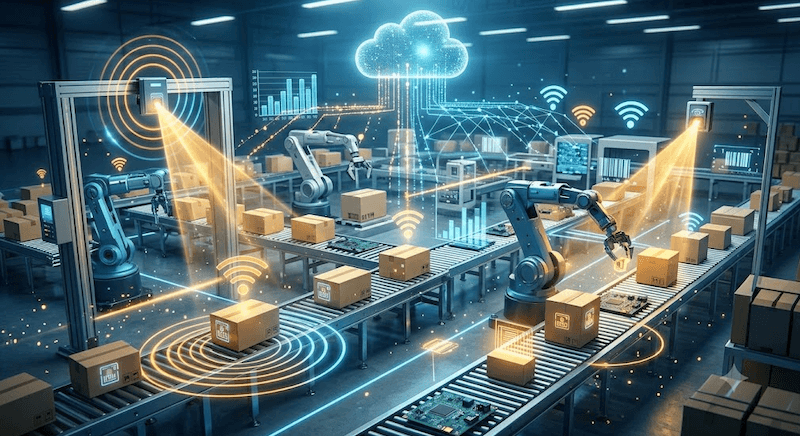
In many factories, information about where goods are, how far a process has progressed or what state a machine is in is still recorded on paper, in spreadsheets or by scanning barcodes by hand. Data arrives late, falls out of sync and depends heavily on the operator. RFID and IoT address exactly this problem: they turn physical events on the shop floor into digital data, captured automatically and in near real time.
How do RFID and IoT differ?
RFID (Radio Frequency Identification) uses radio waves to identify tagged items without contact or the line of sight that barcodes require. A single reader can capture many tags at once, so a whole pallet can be counted in seconds.
IoT (Internet of Things) is a network of connected sensors and devices that measure parameters such as temperature, humidity, vibration, energy use or machine status. If RFID answers “what, where and when”, IoT adds “under what conditions, and how is it running”.
Common applications in manufacturing
- Warehouse management: receiving, shipping and stocktaking through RFID gates, reducing gaps between records and reality.
- Work-in-progress tracking: recording when products pass each process step to measure progress and spot bottlenecks.
- Mold, tool and asset management: knowing where equipment is, who is using it and how many cycles it has run.
- Equipment monitoring: capturing run/stop status and flagging anomalies for proactive maintenance.
- Traceability: linking material lots, process steps and finished goods to trace issues when quality problems occur.
The value is in the data, not just the devices
Tags and readers are only the starting point. Real value comes when data is cleaned, given business context and fed into systems such as WMS, MES or ERP. An event like “pallet A passed gate 3 at 9:15” only matters when the system knows which order the pallet belongs to, where it should go and whether it is on plan.
That is why an RFID/IoT solution typically has three layers: a device layer (tags, readers, sensors, gateways), a middleware layer that processes and filters events, and an application layer where data is visualized, analyzed and integrated with management systems.
Implementation considerations
- Survey the site thoroughly: metal, liquids and tag density strongly affect read performance.
- Choose the right tag for each material and environment (temperature, chemicals, impact).
- Run a pilot (PoC) in one area before scaling, measuring read rates and real-world results.
- Design new operating procedures alongside the technology, with user training.
- Plan data integration from day one instead of building a standalone system.
How Miagi can help
Miagi Solution offers the RFID Traceability platform along with site survey, design, integration and operation services. We start from the factory's specific business problem, pilot at a small scale to measure results, then expand and connect with the systems the business already uses.